
Many investors treat property price forecasts as answers. In reality, they are scenario-based models shaped by changing conditions, not fixed predictions. That distinction becomes more important as the outlook begins to shift.
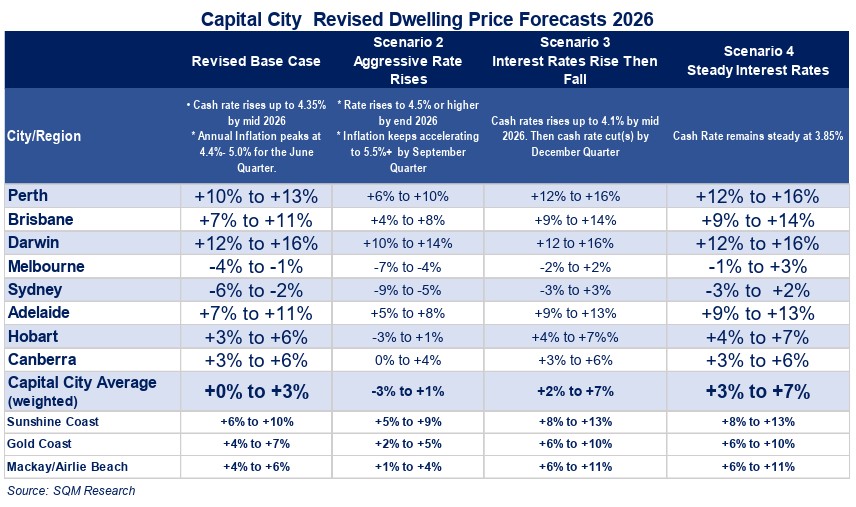
Updated projections for 2026 now point to national capital city price growth of 0% to +3%, down from an earlier expectation of +6% to +10%. The revision reflects tighter financial conditions, including persistent inflation, elevated energy costs, softer migration flows, and the potential for further interest rate pressure from the Reserve Bank.
On the surface, numbers like these can feel decisive. But treating them that way is where many investors go wrong.
What forecasts actually tell you
Forecasts are not designed to predict a single outcome. They model a range of possibilities based on current economic conditions.
A revision from +6% to +10% down to 0% to +3% signals that borrowing conditions are expected to tighten, household budgets are under pressure and overall demand may soften. Those are the conditions being priced into the market.
They are also useful when testing your own position. If interest rates rise further, how does that affect borrowing capacity or holding costs? If growth slows, does that change your timeframe or your tolerance for short-term volatility?
Forecasts can also highlight divergence between markets. Resource-driven cities such as Perth (+10% to +13%) and Darwin (+12% to +16%) are expected to outperform, while Sydney (-6% to -2%) and Melbourne (-4% to -1%) face more headwinds. That contrast can point to where underlying demand is stronger or more resilient.
Used this way, forecasts provide context for how the market is being shaped.
Where investors go wrong
The issue arises when forecasts are treated as conclusions rather than inputs. A city-wide projection is an average across different property types, price points, and locations, many of which respond differently to the same economic conditions.
A projected decline of -4% in Melbourne, for example, does not mean every property will fall by that amount. Well-located assets in tightly held areas with strong rental demand can perform very differently from the broader market.
Another common mistake is relying on a single scenario. The same set of forecasts outlines multiple outcomes depending on how inflation and interest rates evolve. Under a more aggressive rate path, growth could fall to between -3% and +1%. If rates stabilise or ease, outcomes improve to a range of +2% to +7%, and up to +3% to +7% under more stable conditions.
The variation is not a flaw. It highlights how sensitive property markets are to changes in credit conditions and interest rates. Ignoring that range reduces a complex environment to a single number.
What to look at alongside forecasts
Forecasts are only useful when viewed alongside other inputs. At a local level, rental vacancy rates and yield trends often provide a clearer indication of demand. Supply pipelines, including new developments and approvals, help identify where future competition may emerge.
Infrastructure investment and employment growth also play a role in shaping long-term demand, often in ways short-term forecasts do not fully capture.
Then there is your own position. Borrowing capacity, tax structure, investment timeframe and risk tolerance all influence what is appropriate, regardless of what a headline forecast suggests.
This is where a strategy-led approach becomes essential. The focus shifts from reacting to forecasts to understanding how a specific asset performs under different conditions, and whether it aligns with a longer-term objective.
Forecasts will continue to change as new data emerges. The more useful question is not whether they are right or wrong, but how they fit into the broader picture you are working with. The key is not to predict the market, but to ensure your position remains sound across a range of outcomes.
At SAFORE, we help investors interpret market data in the context of their broader property strategy. If you are assessing your next investment or reviewing your current position, a discovery call can help you understand what the numbers mean for you. Book a Discovery Call.