



More Australian property investors are selling, but deciding to sell and having a good reason to sell are two different things.
The Property Investment Professionals of Australia’s (PIPA) 2026 Annual Investor Sentiment Survey found 18.3% of investors sold at least one investment property in the year to August, up from 16.7% in 2025 and 14.1% in 2024. PIPA describes this as the highest rate of investor exits in the survey’s recent history.
But those numbers raise an important question. Are more properties genuinely no longer worth holding or are investors responding to an environment that has simply become more uncomfortable?
Why are seasoned investors selling?
These aren’t short-term speculators, but seasoned, long-term landlords. More than a third of sellers (37.1%) had held their property for 10–20 years, the most common holding period in the survey.
Their reasons suggest owning property has become harder. Rising holding and compliance costs such as insurance, minimum standards and property management fees topped the list, followed by land tax and government charges.
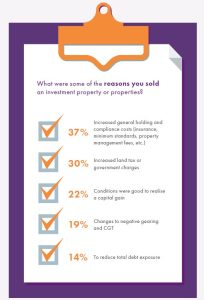
Some 41.7% of investors saw operational costs rise by 11%–20% over the year, and 62.3% say their portfolio is in negative cash flow, up from 56%.
But there’s a difference between an investment becoming harder to hold and an investment no longer being worth holding.
Interestingly, only 7.6% of respondents think now is a good time to sell, down from 36% in 2025. So investors aren’t necessarily selling because they believe market conditions make it an attractive time to do so. In many cases, the cost or complexity of holding an investment has increased.
That matters because an investment becoming harder to hold isn’t automatically the same thing as it no longer being worth holding.
Has the reason you own the property changed?
Markets change. Costs change. Policies change. Life changes. The real question is whether those changes have materially altered the reason you own the property.
Say you bought in an area where the population was growing, housing supply was tight and tenants were in demand. You planned to hold for 15 years. Five years later, your insurance, land tax and interest costs have all gone up.
That may make owning the property less comfortable and reduce its cash flow. But before deciding to sell, it is worth going back to the original investment case.
Is rental demand still strong? Are the area’s long-term growth drivers still intact? Is the property performing broadly as expected? Can you sustainably manage the higher holding costs? And, importantly, does the property still have a role to play in the wealth strategy you originally built around it?
If the answers are largely yes, selling because the current environment feels difficult may turn a short-term reaction into a long-term decision. Property investment has always involved periods when costs rise, markets slow or policy settings become less favourable.
The calculation is different when those changes undermine the investment case itself.
Perhaps rental demand has weakened, substantial new supply is coming, the property needs significant ongoing spending or its growth prospects no longer justify the holding costs. Or perhaps the property is placing enough pressure on your cash flow that continuing to hold it is compromising other financial goals.
In those circumstances, selling isn’t an emotional response to a difficult market. It may be a rational change of strategy.
Sometimes it is your strategy that has changed
Some reasons to sell have little to do with performance. Reducing debt, freeing up capital for a better opportunity, rebalancing a concentrated portfolio or adapting to changed family or retirement plans can all make selling a deliberate strategy.
That distinction is important. An investment property can still be a reasonable asset while no longer being the right asset for you.
Perhaps you bought it primarily for long-term growth but you’re now approaching retirement and want to reduce debt. Perhaps too much of your wealth is concentrated in residential property. Or perhaps selling would release capital that could be put to better use elsewhere.
In each case, the reason for selling isn’t that the property market has suddenly become ‘bad’. It is that the property’s role within your broader strategy has changed.
Look at what selling achieves
The decision shouldn’t end with whether you still want the property. You also need to ask what selling would accomplish.
That means comparing the likely outcome of holding with the likely outcome of selling: cash flow, debt, tax, selling costs and what you’d do with the released equity. If you plan to reinvest, the quality and cost of the replacement belong in the calculation too.
Current tax settings also need to be considered. Residential investment properties acquired before 7.30pm AEST on 12 May 2026 are grandfathered under the government’s negative gearing reforms. From 1 July 2027, investors who acquired an established property after that date will no longer be able to offset its rental losses against non-property income such as wages, although those losses may still be offset against residential property income or carried forward.
That means selling a grandfathered property and later buying another established property could change the tax treatment available to you, so tax consequences should form part of the decision rather than being considered afterwards.
Ultimately, the question isn’t simply whether owning an investment property has become more expensive, more complicated or less appealing than it was a few years ago.
It is whether the reasons for holding it still stack up.
Selling isn’t inherently a mistake, just as holding isn’t inherently the disciplined choice. What matters is whether something fundamental has changed – and whether selling puts you in a stronger position to reach your long-term goals.
At SAFORE, we look at each property as part of your broader wealth strategy rather than in isolation. If you’re questioning whether a property still deserves its place in your portfolio, speak with the SAFORE team about reviewing your strategy before you decide.