




As Australia’s property market slows, the balance of power is shifting from sellers to buyers.
Many investors spend years waiting for the market to soften, yet when those conditions finally arrive, uncertainty often keeps them on the sidelines. When prices are rising and market euphoria takes hold, buyers are eager to enter the market. But when confidence falls, the opportunities investors have been waiting for may finally begin to emerge.
Some of the best buying opportunities can arise during these quieter periods, when buyers have more choice, properties take longer to sell and vendors are more willing to negotiate.
One principle that has stood the test of time is that you make money in property when you buy, not when you sell. The location you choose, the price you pay and the quality of the property you purchase can have a lasting impact on your investment returns.
That doesn’t mean every discounted property is a bargain or that now is the right time for everyone.
The real opportunity lies in recognising the right property, at the right price, supported by a clear, long-term strategy.
The latest property data
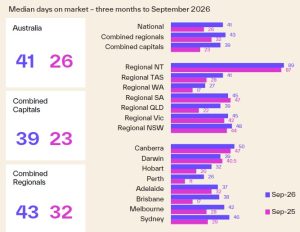
According to Cotality’s October 2026 Housing Chart Pack, properties took a median of 41 days to sell nationally over the three months to September, up from 26 days a year earlier.
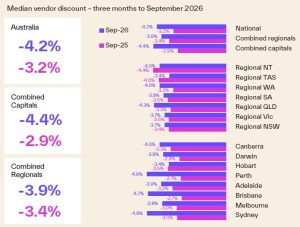
The median vendor discount – the gap between initial asking and final sale prices – also widened from 3.2% to 4.2% nationally. In the capital cities, it reached 4.4%, up from 2.9% a year earlier.
Stock is building. Over the four weeks to 11 October, total listings rose 19.1% compared with a year earlier, even though new listings fell 7.9%. With unsold properties accumulating and September sales down an estimated 20.9% year on year, buyers have more negotiating power.
What this means for investors
One of the biggest advantages of a quieter market is something buyers rarely have when competition is strong: time.
More time to explore your options, understand what you’re buying and make informed decisions without the pressure of competing buyers. That includes reviewing comparable sales, assessing rental demand and arranging building and pest inspections.
Vendors whose properties attract little interest may be more open to lower offers or favourable contract terms. This could make quality properties in once-competitive locations more accessible.
That doesn’t mean every seller will negotiate or every market has shifted equally. Desirable properties can still attract strong competition, while conditions vary considerably between cities, suburbs and property types.
The opportunity isn’t simply about paying less. It’s about having the time, choice and negotiating power to secure a quality investment on terms that may not have been possible when competition was stronger.
A discount isn’t always a good investment
Negotiating a lower purchase price is only worthwhile if the property represents good value in the first place.
Consider this example: A property listed for $700,000 is purchased for $650,000. The $50,000 discount might appear attractive, but it means little without understanding the property’s underlying value. If comparable properties are selling for $620,000, the buyer may still be overpaying.
The same principle applies beyond the purchase price. A property can look cheap relative to where it was priced 6 months ago and still be a poor fit for an investor’s strategy.
A well-priced property could deliver disappointing returns if rental demand is weak, maintenance costs are high or new housing supply is planned nearby.
Rather than focusing on how much you’ve negotiated off the asking price, start with a more important question: is this actually a good investment?
- Does the location have the jobs, infrastructure, population growth and amenities that could support future demand?
- What are vacancy rates and achievable rents telling you about the rental market?
- Is substantial new housing supply planned?
- What condition is the property in and what might it cost to maintain?
- And do the likely rental yield, holding costs and capital growth prospects stack up at the price you’re considering?
Those fundamentals matter in any market. They arguably matter even more when values are falling, because today’s discount doesn’t guarantee tomorrow’s recovery.
Strategy should determine when to buy
No one can consistently predict the exact bottom of a property market. By the time confidence returns and prices begin rising again, some of the better buying opportunities may have already passed.
But that doesn’t mean you should rush into a purchase. The decision should always come back to your financial position, the quality of the investment and whether it supports your long-term strategy.
If a property aligns with your long-term goals, the numbers stack up and the fundamentals remain strong, a quieter market could present an opportunity to negotiate. If those things don’t stack up, even a larger discount won’t make it a good investment.
Borrowing capacity also deserves close attention. Cotality estimates the four rate rises from February to September reduced borrowing capacity for a median-income household by almost $90,000.
That’s an important part of the current market equation. Buyers may have more negotiating power over vendors, while higher interest rates have reduced how much they can borrow and increased the cost of holding an investment.
Investors need confidence they can cover repayments and holding costs if interest rates rise further, rental income falls short or unexpected expenses arise.
As 2026 draws to a close, changing market conditions are creating a different environment for buyers. Less competition, greater choice and more room to negotiate could present opportunities for investors who are financially prepared and know what they’re looking for.
The challenge isn’t predicting exactly when the market will turn. It’s recognising genuine value when opportunities arise and having the confidence to make informed decisions.
Uncertain markets don’t remove opportunity. They make having the right strategy more important.
At SAFORE, we believe successful property investing starts with understanding your circumstances, your financial position and what you’re working towards. If you’re considering your next investment, a strategy session can help you assess the opportunities and risks before making a decision. Click here to book your strategy session.