Property prices may be falling across much of Australia, but that doesn’t tell the whole story for investors. Rental markets remain tight and rents are continuing to rise.
Cotality’s September Home Value Index showed national home values fell 0.9% between July and August, the fifth consecutive monthly decline. Values are now 3.6% below their March peak, with 93% of capital city suburbs recording a fall over winter.
But while property prices have softened, rents have held up strongly.
Vacancy rates remain tight
SQM Research recorded a national residential vacancy rate of 1.3% in July, unchanged from June and well below the 2–3% level generally considered a balanced market. Conditions were even tighter in Brisbane, Perth, Adelaide, Darwin and Hobart, where vacancy rates remained below 1%.
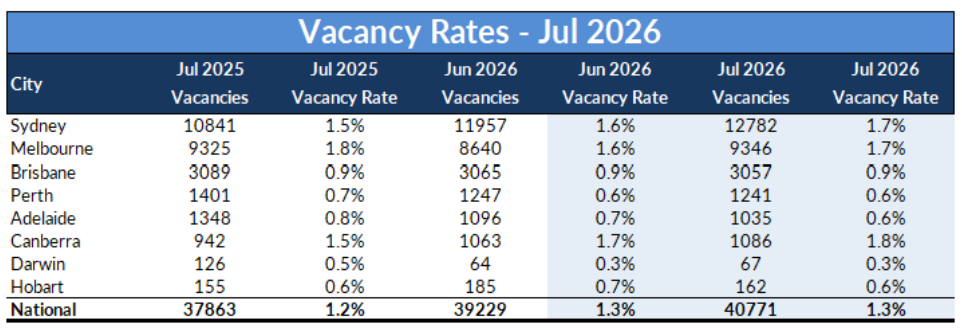
For investors, low vacancy rates can mean less time without a tenant and stronger demand for their property. But it’s important to remember that conditions can vary considerably from one market to another.
Rental conditions have remained tight even as property prices have fallen. Buyer demand may have softened, but the rental market is facing a different problem: there still aren’t enough available rental properties to meet demand.
Where is rental growth strongest?
With so few rental properties available, rents are continuing to rise. SQM Research found national combined advertised rents were 7.2% higher over the year to August 2026, reaching an average of $698.45 per week.
Some of the strongest rental growth has occurred in the tightest rental markets. Darwin, where the vacancy rate was just 0.3%, recorded 14.1% annual combined rent growth, while Hobart, with a 0.6% vacancy rate, recorded 12.2% growth. Brisbane rents increased 8.3% over the year.
Property type matters too. Nationally, advertised unit rents increased 7.7% annually, compared with 6.8% for houses. For investors, this is a good reminder not to rely on headline numbers alone. Where you invest matters, but so does the type of property and what local tenants are actually looking for.
Why could rental conditions remain tight?
One of the biggest reasons rental conditions remain tight is simply that Australia is not building enough homes.
The National Housing Supply and Affordability Council now expects the government’s 1.2 million home target to be reached later than originally forecast, while rising construction costs continue to put pressure on new housing supply.
Recent property tax changes announced in the 2026/27 federal budget are also likely to change how investors approach the market. While the government is trying to direct more investment towards new housing, I believe there is a real risk these changes could make an already difficult rental supply problem worse.
From what I’m seeing, investors are becoming more cautious, and some will simply step back altogether. The full impact may not be obvious straight away, but over the next one to two years, fewer investors could mean fewer rental properties available at a time when supply is already critically tight.
If that happens, tenants will ultimately feel the pressure through even tighter rental conditions and higher rents. In my view, that is the part of the policy debate that is not getting enough attention.
For investors, lower property prices combined with stronger rents are also starting to improve rental yields. According to Cotality, the national gross rental yield reached 3.8% in August.
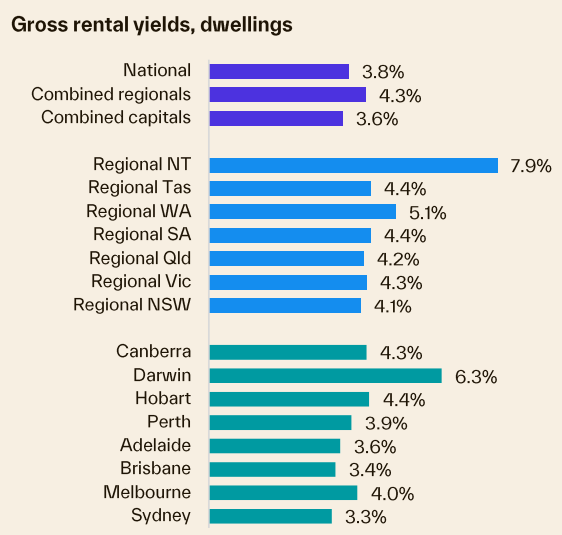
That was the highest level since September 2019. However, yields in many of the larger capital cities may still not cover all the costs of holding an investment property.
For investors, falling prices don’t necessarily mean it’s a time to sit on the sidelines. In some markets, softer prices can create better buying opportunities, particularly where rental demand remains strong and the property still stacks up on the fundamentals.
The key is not simply buying because prices are down. It is using the market conditions to buy well, in the right location, at the right price and as part of a clear investment strategy.
Finding the right investment opportunity
Strong rental conditions do not make every property a good investment.
Rental income is important, but it is only one part of the decision. Investors also need to consider future housing supply, population and employment growth, the quality of the property itself and its potential for long-term capital growth.
At SAFORE, we look beyond the headline numbers. Rental income matters, but so do the market, the property itself and how it fits into your broader strategy.
The aim isn’t simply to find a property with a strong rental yield today. It’s about finding the right property, in the right market, that supports your longer-term investment goals.
If you’re considering your next property investment, speak with the SAFORE team about building a strategy around your goals, financial position and longer-term plans.